

Entry tags:
The Red Caviar Problem in the USSR
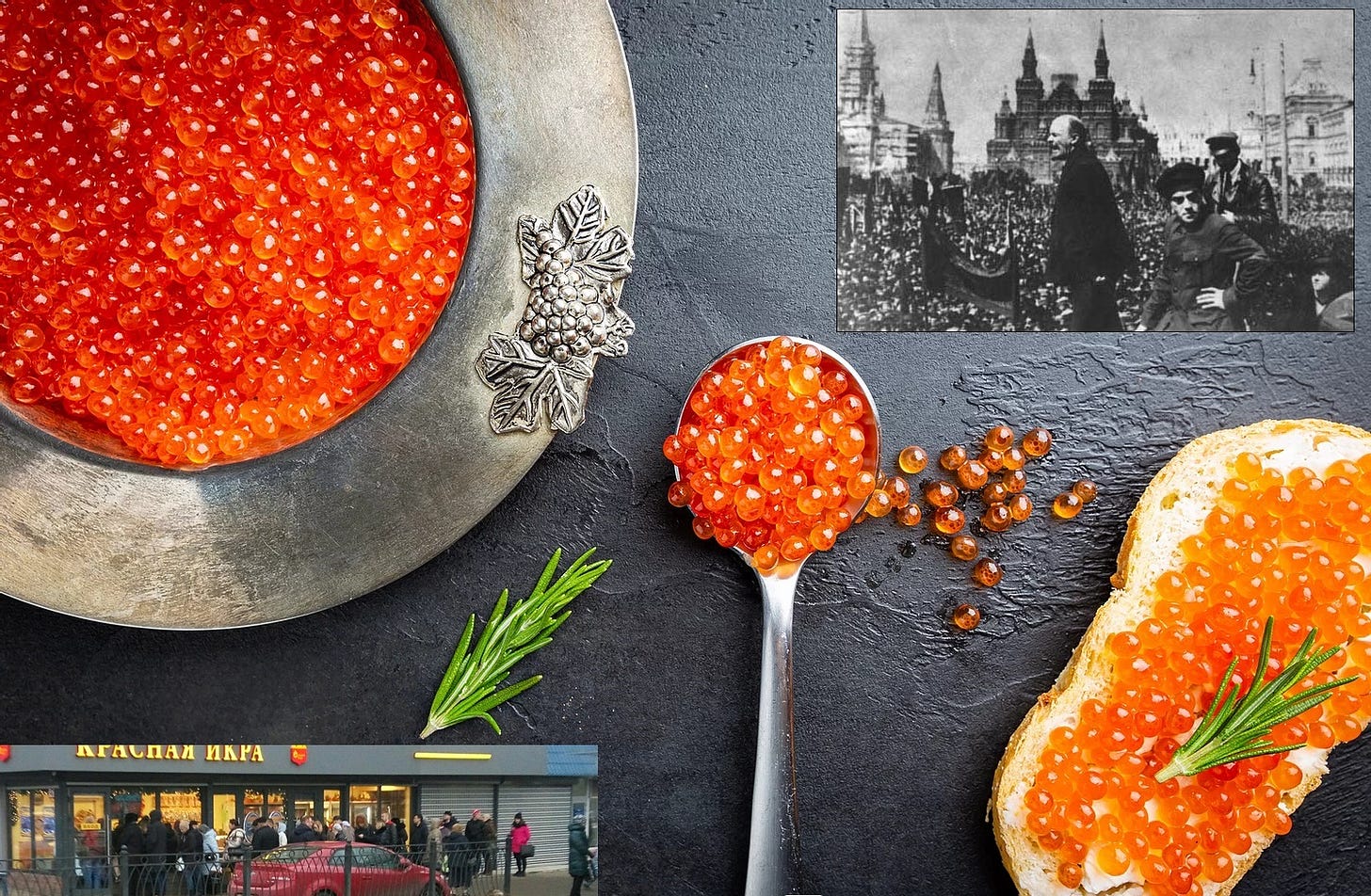
Whenever the topic of "distribution according to needs" comes up, it goes hand in hand with the topic of rationing and of the definition of "needs", which is a double-edged thing. On one edge there is the effective restriction of the "needs" (at least from the present day perspective), and on the other, the question as to who is going to make decisions about the restrictions - what to restrict, to which exact amount and for whom. In addition, what consequences suboptimal decisions about rationing tend to have?
In this regard, the practice of "real socialism" in the Soviet Union gives quite a few examples that must be considered for future reference. One of the most glaring of such examples and the one that almost invariably comes up among the Russian speakers when these topics are discussed, is the "Red Caviar Problem".
Caviar is basically fish's eggs. That's why it is very nutritious as food and contains almost all vitamins and such. On top of that, it tastes deliciously and the red sorts of it even pop in your mouth like bubble wrap. So it's safe to say that caviar is a product of particular dietary and culinary value.
But at the same time, it doesn't take any more labor or energy input to make and preserve it, than most other fish products. Thus, there is no reason why members of a communist society (even in its lowest stage) should be denied it. Except for the fact that the fish species from which caviar is extracted are rather rare. So, there is natural scarcity of caviar. Even today, when the technology of aquaculture and fish farms has been developed, you don't see caviar competing against tuna, let alone pork and chicken...
Back in the USSR, when consumer prices were fixed by the government and in theory had to reflect the socially necessary labor time that went into production of the goods, caviar was pretty cheap. Every worker and collective farmer could afford to buy some. But the supply was naturally very short of the demand. The total amount of black caviar extracted in the USSR was ~2000 tons per year. If we assume for simplicity the population of the USSR as ~200 million citizens, average annual per capita consumption would be ~10 grams, or a full teaspoon! That is, if it were not exported to the "free world" at market prices nominated in very green and much appreciated dollars...
Red caviar was more abundant and not so lucrative in the world market due to competition from Japan, so it was more available to the ordinary Soviet citizens. Yet it was still a "premium" good.
The government had to ration it one way or another. In fact, there were several ways. It started with the "special dispensaries" for certain privileged categories, such as "responsible" Party and Soviet officials, ranking military and police officers, etc. Caviar was available for purchase there more or less regularly at fixed prices. From there, as well as from poachers, caviar flowed to the black market, where it sold for ten times the fixed price. Corruption bloomed, of course, to the point that a deputy minister of the fishing industry was tried and shot - at the end of Brezhnev's rule, when such things weren't really common.
To ordinary citizens caviar was available every day only in high-end restaurants and theater buffets. The restaurants were allowed to put a high mark-up on top of the wholesale price (justified as per the service of the chefs and waiters) and the theater/concert hall buffets were sites of rather unbecoming stampedes the less cultured representatives of the most cultured Soviet citizenry went on to grab a sandwich or a cake during the short intermissions in the performances, so the price of caviar there was inconsequential anyway.
At the factories, research institutes, etc., there were "bureau of orders" operating under the trade unions umbrella, which offered a variety of goods unavailable in common retail stores (like those imported from the ComEcon countries). But there were certain shenanigans. First of all, to place an order for the thing you really wanted (like caviar), you would usually have to accept a "load", i.e. some junk (like a broom, shoe wax or stationery) that you didn't really need, but the 5-year plan had provisioned to "realize" to the populace. Then the amount of orders available at any given time was limited, and you'd have to wait for your turn after you made one, so you could easily miss out on something (like caviar), if you had timed another order less than optimally. Needless to say, petty corruption flourished there too, and you'd better had a certain skill to navigate that trade union environment of favoritism and the "telephone law", to make a steady use of it. And if you weren't a good boy, had multiple or recent disciplinary run-ins with the higher-ups, this bureau would be effectively closed for you.
But in the weeks leading up to major holidays (1st&9th of May, 7th of November and especially the New Year) stockpiles of red caviar were dumped upon the retail stores all over Moscow, Leningrad and other major cities. The rule "no more than X cans in 1 pair of hands" had to be observed to prevent immediate rushes. Still, people who would like to hoard some for other special occasions (birthdays, weddings, etc.) or for speculation would do so by circling around several stores and so on. People from small towns and the countryside would also come in what was colloquially called "sausage trains" and, depending on luck and "connections", get their more or less fair share of the delicacies. So, the stores would run out of the allotted supply earlier than expected and then have to wait to be restocked. Rumors would start to circulate about which store and when was about to "cast it out" on the shelves again. People then would come en masse and form queues, some making arrangements and calling favors with their colleagues and managers at their workplaces to leave early in the day to have better chances of catching the desired gourmet. But then the rumors often proved false and the shelves remained empty. The crowd would naturally get agitated, suspecting foul play and what not. And at that moment of high tension a snarky store manager would come out and announce: "Dear customers! Comrades! The Politburo has convened and declared that today there is no need of red caviar!" One can only imagine what the disappointed people thought of the wisdom of the Politburo, the fat cheeks of the store manager and the communist system in general (on the eve of the official holidays).
( Read more... )